
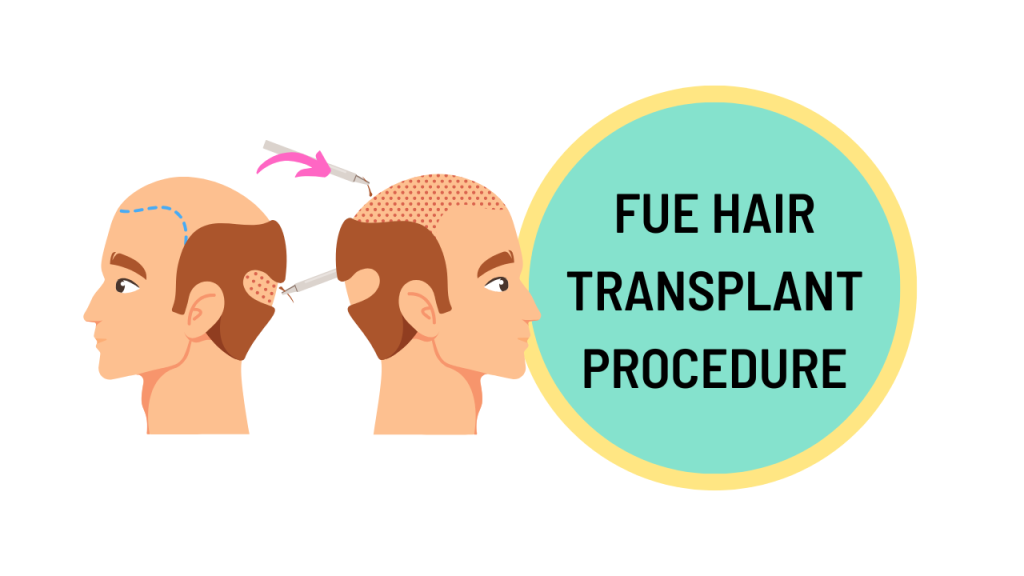
If you’re here, then you’re probably deep in the process of researching follicular unit extraction (FUE) hair transplants. You have an idea of what an FUE is, but what happens during the actual procedure? What will your day look like from the moment you walk into the clinic to the moment you leave?
For background, I used to work as a surgical assistant at a top hair transplant clinic. I’ve been part of a couple hundred hair transplant procedures—the majority of which were FUEs. From my behind-the-scenes perspective, I’ll walk you through exactly what happens during an FUE procedure so you know exactly what to expect.
Note: This article is specifically discussing FUE hair transplants. There’s also another type of hair transplant called follicular unit transplantation (FUT) that I cover in a separate HowMedWorks article
.
Table of Contents
The 6 Steps of an FUE Hair Transplant Procedure
An FUE hair transplant can be broken down into six main steps:
- Pre-op
- Injecting local anesthesia
- Harvesting
- Creating recipient sites
- Transplanting
- Post-op
Here’s an in-depth breakdown of each of them.
FUE Hair Transplant Part 1: Pre-Op
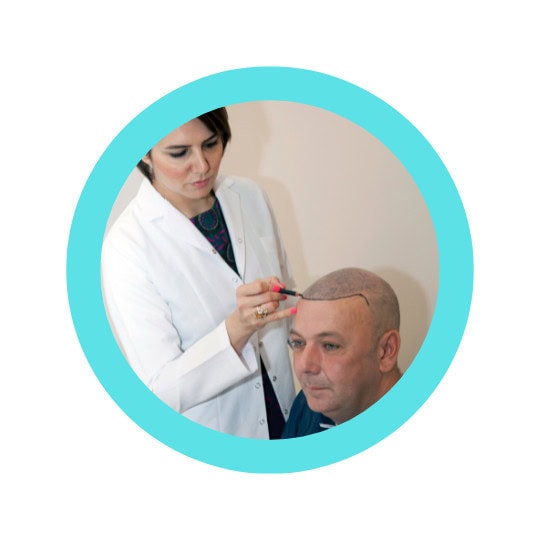
Pre-op is the first step of any hair transplant procedure. Pre-op includes everything that happens before the actual surgery, such as:
- Reviewing pertinent information
- Taking “before” photos
- Changing into a surgical gown
- Checking vitals
- Taking pre-op medications
- Shaving the donor and/or recipient area(s)
- Mapping out the donor and recipient areas
The donor area must be shaved. However, many surgeons will give you the option to not shave the recipient area. From a former surgical assistant’s perspective, I would highly recommend shaving down all of your hair if possible, especially for cases where graft counts are 2,000 or more.
Note: A graft is a tiny unit of tissue containing one to three hair follicles. These are what get removed from the back of your head and transplanted to the front.
There are two main reasons for this: to allow the surgical team to work more efficiently and to have the best possible end results. For starters, short hair gives us better visibility. As you can imagine, trying to navigate through long hair to place grafts is much harder, not to mention extremely time-consuming.
Plus, your long hair can easily catch on the grafts and pull them out before they’ve properly healed. That’s a waste of grafts and money, since you’re paying for each graft regardless of whether it survives or not. Therefore, for best results, it’s best to shave both the donor and recipient areas.
Story time: I recall several difficult cases made even harder by patients refusing to shave their recipient areas. Many of those procedures ended up taking twelve hours. (Keep in mind that you’ll need to sit very still the whole time.)
Also, the longer the procedure runs, the more times the team will need to re-inject anesthesia as it starts to wear off. The act of injecting itself means not only more discomfort but also an increased risk of already-placed grafts popping back out!
FUE Hair Transplant Part 2: Injecting Local Anesthesia
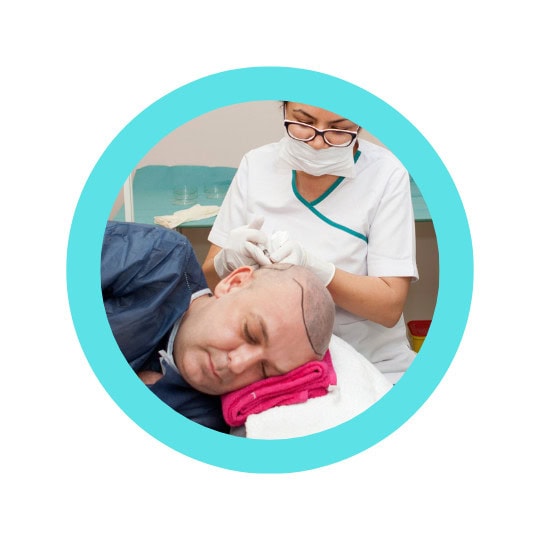
The second step of an FUE procedure is anesthesia. The nurse, physician associate/assistant (PA), and/or surgeon will inject local anesthetic into the donor area so it stays numb and painless when grafts are harvested later. For most patients, this is the most painful part of the whole procedure.
Afterwards, you should be able to feel pressure, but you shouldn’t feel any pain. If you still feel any stinging and burning, be sure to let the surgical staff know. The local anesthesia along with the oral sedative taken during pre-op should keep you relaxed and pain-free throughout the procedure.
Note: A lot of patients have compared the numb sensation all over the head to feeling like they’re wearing a helmet.
FUE Hair Transplant Part 3: Harvesting
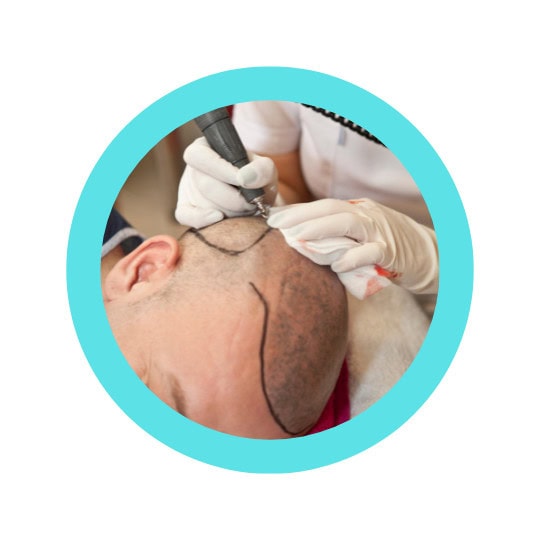
The third step of an FUE procedure is harvesting grafts from the back and/or sides of the head that will later be transplanted. Depending on the clinic, this will be done by either the physician associate/assistant (PA) or surgeon.
Fun fact: It’s a big misconception that a PA can’t do as good of a job at harvesting grafts as a surgeon. It’s actually the opposite. In hair transplant clinics where there’s a PA, it’s usually the PA’s job to do all of the harvesting, not the surgeon’s. The only times that the surgeon will do the harvesting is if a patient requests it, or the PA is out of office. Otherwise, harvesting grafts isn’t something that the surgeon routinely does.
In other words, you want the PA to be doing the harvesting because he or she spends more time doing it on a regular basis. It’s kind of like how you want the nurse to draw your blood and not the doctor because the nurse spends significantly more time doing that particular task.
The harvesting portion of an FUE procedure usually takes a few hours. During this time, you’ll be lying down. A rapidly spinning cylindrical punch—approximately one millimeter in diameter and 4 millimeter deep—will be used to make hundreds to thousands of tiny incisions around individual hairs or groups of hair. These grafts are carefully lifted out of the scalp using tiny forceps and separately inspected under the microscope by the surgical assistants to ensure that they’re suitable for transplant.
Note: The punch machine makes a “whirring” sound that might be off-putting, but you shouldn’t feel any pain during this process. If you do, be sure to let the team know.
The grafts that are selected for extraction are spread out over a large area across the back and sides of the head in order to avoid any noticeable patchiness or thinning. These grafts will later be transplanted in the recipient area.
Question: Can I receive donor hair from someone else?
Answer: Unfortunately, you can’t use someone else’s hair for a hair transplant. However, there is one exception: theoretically, it would be possible for an identical twin to give donor hair because they’re a blood type and tissue match.
However, it’s unlikely that you have a twin, and, even if you do happen to have one, they’re probably also experiencing something similar with their hair situation since you share the same DNA. 😜
FUE Hair Transplant Part 4: Creating Recipient Sites
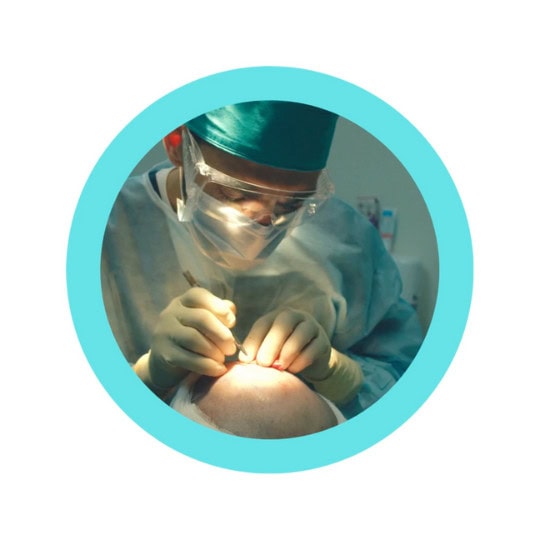
The fourth step of an FUE procedure is creating the recipient sites in which all of the individual grafts will be placed. (From this point onward, you get to sit up!)
After lying down for the harvesting portion, you’ll be moved to a sitting position for the rest of the procedure. The surgeon will inject local anesthetic into the recipient area (usually the hairline and crown) to numb it completely.
Once the area is numb, the surgeon will start creating recipient sites, which are tiny incisions where each individual graft will be placed. This is one of the most critical parts of the entire procedure because the angle, direction, and depth of these incisions determine how natural your final results will look.
The surgeon uses a small, precise blade to create these sites. They’ll carefully consider the natural hair growth pattern, ensuring that each incision is made at the correct angle so that the transplanted hair grows in the right direction. The spacing between sites is also crucial (i.e. too close together and you risk damaging grafts, too far apart and you won’t achieve the desired density).
During this time, you’ll need to look straight ahead. No reading books or using your laptop, but you can put on your favorite show or movie to watch. (The offices have TVs.) Some offices will allow you to use your phone as long as you can hold it straight out in front of you and face directly forward.
This usually takes thirty minutes to an hour, depending on how many grafts you’re getting. After the recipient sites are created, you’ll get a lunch break. This gives the surgical team time to prepare for the transplanting phase, and it gives you a chance to eat, walk around, and use the restroom.
FUE Hair Transplant Part 5: Transplanting
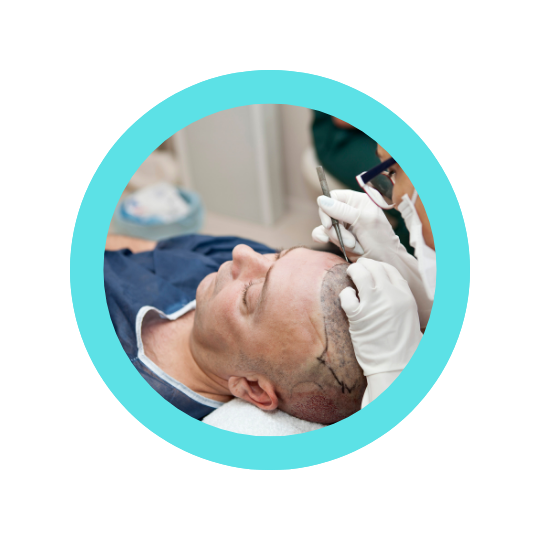
Now comes the longest part of the procedure: transplanting the grafts into the recipient sites. This is where all those carefully harvested grafts from earlier get placed into the tiny incisions that the surgeon just created.
You’ll be sitting up during this entire portion, and you’re welcome to watch TV, listen to music, or just relax. The transplanting phase typically takes around four hours for an average case of 2,000-2,500 grafts.
The actual transplanting is mainly done by the surgical assistants, with help from the nurse and PA. Since there are hundreds if not thousands of grafts to place, the surgical assistants work in teams, with two or three assistants placing grafts simultaneously to speed up the process.
Each graft is carefully picked up with tiny forceps and gently placed into a recipient site. It’s incredibly meticulous work. The graft needs to be inserted at the correct depth and angle, and we have to make sure not to damage the delicate follicles.
Note: About one millimeter of each graft will stick out of the skin. Although this might be unsightly at first, it is necessary for smooth results. Pushing the grafts completely into the skin can result in dips in the skin, as well as ingrown hairs, and we don’t want that.
To get a better visual idea, feel free to check out this animation video (2:30) that gives a nice overview of what happens during an FUE procedure.
Fun Fact: While it’s technically possible to transplant hair from the beard, it’s not common. The texture of facial hair tends to be much thicker and coarser than scalp hair so it doesn’t always blend well with your existing hair. It’s usually only considered when there isn’t enough donor hair available from the back and sides of the head.
FUE Hair Transplant Part 6: Post-Op

Once all the grafts are in, you’re pretty much done! Post-op is the final step of an FUE procedure.
The surgical team will clean up the donor and recipient areas, take “after” photos, and provide you with post-operative care instructions. You’ll be given medications to take home, including antibiotics to prevent infection and pain medication, though most FUE patients don’t end up needing the pain meds and just use over-the-counter analgesics.
You’ll also receive detailed instructions on how to care for your newly transplanted hair. This includes:
- How to sleep (i.e. usually elevated at a 45-degree angle for the first few nights)
- When you can shower (i.e. typically after 24 to 48 hours)
- How to properly wash your hair (i.e. patting only for the first couple of days)
- What activities to avoid (i.e. no heavy exercise, bending over, or anything that increases blood flow to the head for the first week due to the risk of grafts popping out)
- What symptoms are normal versus what should prompt a call to the office
The next day, you’ll have a hair wash appointment where the clinic will show you the proper technique for washing your hair without dislodging any grafts. While optional, I strongly recommend you go because the team will also check to make sure everything is healing properly.
Follow-up appointments are typically scheduled every few months to monitor your progress, though the exact schedule depends on the surgeon’s preference. At these appointments, they’ll take photos to document your hair growth and address any concerns you might have.
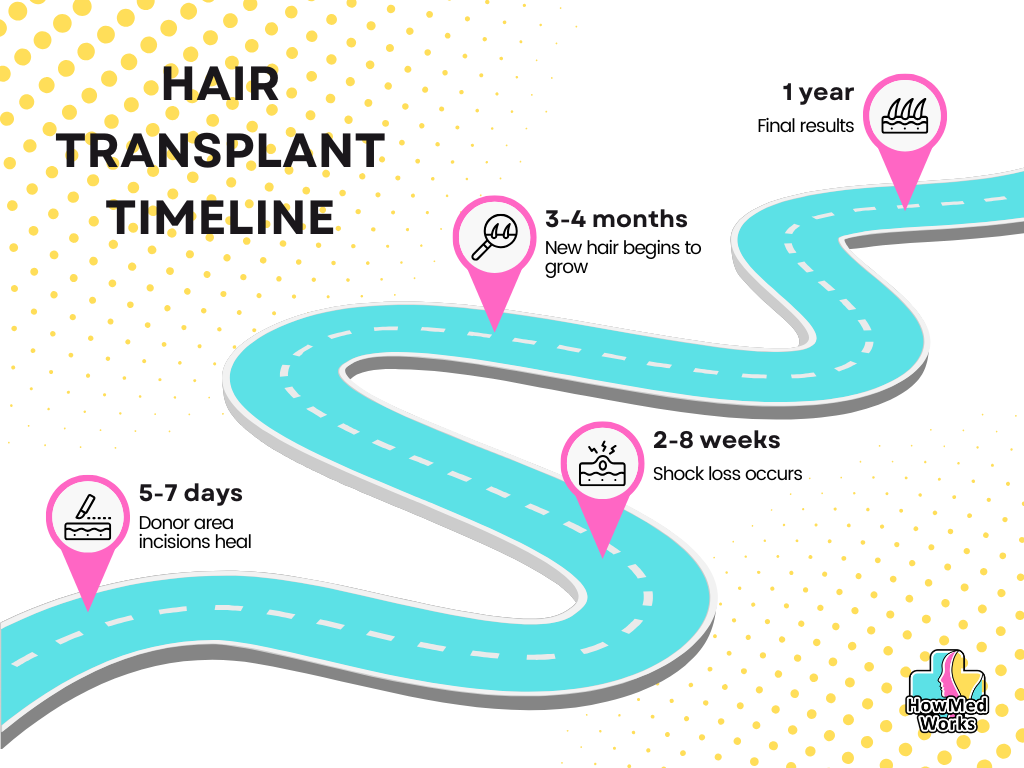
Typically, it takes three to four months to start seeing new growth from a hair transplant and one year to get your final results. This is because hair follicles have a dormant cycle that lasts for several months before new hair begins to grow.
Note: If you notice your newly transplanted hair starting to fall out within the first few weeks, don’t panic—this is completely normal and expected! This temporary shedding, known as “shock loss,” occurs when transplanted follicles enter their resting phase. However, the roots remain intact and will produce new, permanent hair growth in the months ahead.
As a visual reference, here’s what you should expect in terms of a timeline for hair transplant results:
Conclusion
There you have it—the complete step-by-step breakdown of what happens during an FUE hair transplant procedure! From walking in for pre-op to leaving with your new grafts, now you know exactly what to expect.
If you’re seriously considering an FUE hair transplant, make sure to do your research and choose a reputable surgeon. Ask lots of questions during your consultation, look at before and after photos, and make sure you feel comfortable with the entire team.
For more information about FUE hair transplants, check out my other article: Everything to Know About FUE Hair Transplant: A Surgical Tech’s Perspective. I cover topics like costs, success rates, and healing times.
Stay healthy and keep learning! 😀